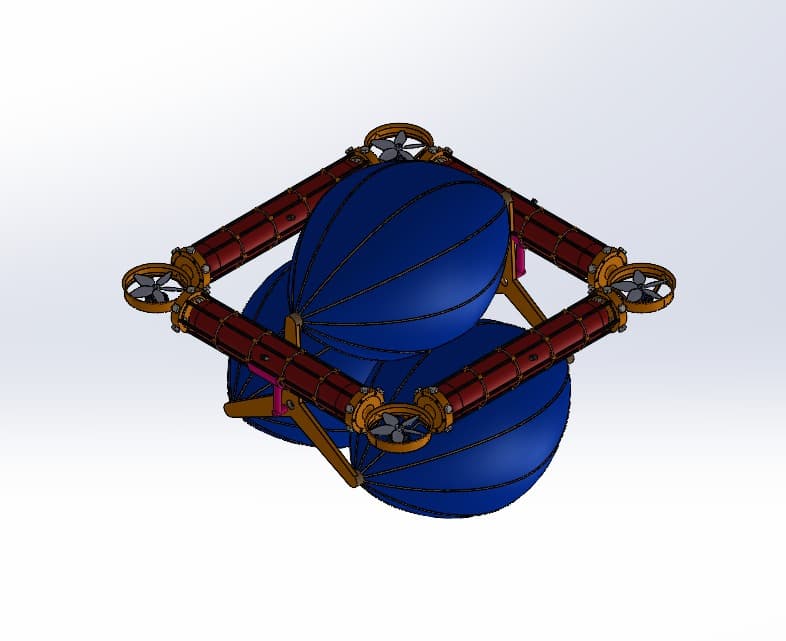
The Baldrone Project
Exploring persistent aerial surveillance through lighter-than-air autonomous infrastructure.
Mission
The Baldrone Project was an early exploration into creating a persistent aerial surveillance platform capable of remaining airborne for extended durations above dense urban environments. The objective was to rethink conventional drone operations by reducing dependence on active piloting, frequent landings, and limited battery endurance.
The project investigated whether a geo-fenced helium-assisted aerial platform could provide continuous situational awareness for applications such as urban monitoring, emergency response, and policing. A major focus was placed on enabling long-duration flight while minimizing onboard weight and operational complexity.
At its core, the mission was not simply to build another drone, but to explore the possibility of treating aerial visibility as a form of deployable infrastructure rather than an on-demand aviation asset.
Execution
The project began with the development of conceptual lighter-than-air drone architectures that combined buoyancy with autonomous stabilization and surveillance payload integration. Multiple energy delivery approaches were explored to overcome the endurance limitations of battery-powered systems.
One major avenue of experimentation involved studying wireless energy transmission using microwave and laser beaming systems to continuously power the platform mid-air while also investigating whether the same beamforming architecture could support simultaneous data transmission. This led to research into rectennas, optical power receivers, beam steering, and persistent communication links for airborne systems.
As the project evolved, practical limitations involving safety, atmospheric interference, infrastructure complexity, and regulatory feasibility became increasingly evident. These findings ultimately shifted the design philosophy toward infrastructure-assisted charging methods using distributed rooftop docking and charging systems, which proved to be significantly more scalable and deployment-friendly for dense urban environments.
The Baldrone Project became one of the earliest conceptual iterations that eventually contributed to the development direction of Wideband Sentinel.
Technologies
- Telemetry
- Mechanical Design
- Solidworks
- Flight Software
- Systems Engineering
- UAV Architecture & Concept Development
- Microwave Energy Beaming
- RF Systems Fundamentals
- Power Systems Engineering
- Beamforming & Directional Communication
- Rapid Engineering Prototyping