RESCO for Urban Residential Community
Renewable Energy-as-a-Service Company
Mission
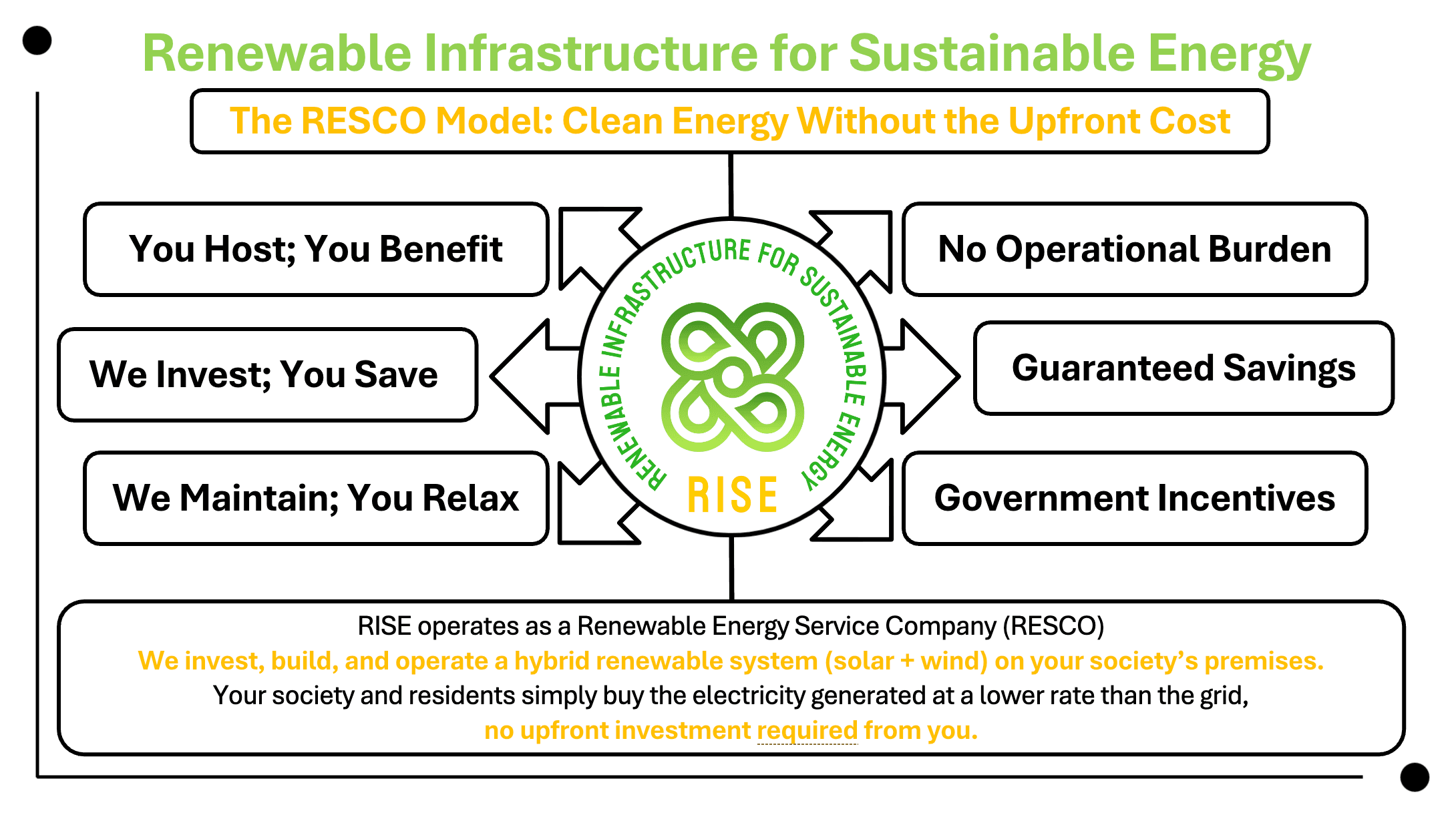
RISE (Renewable Infrastructure & Sustainability Engineering) was conceived as an attempt to make rooftop renewable energy financially accessible to dense urban residential communities through the RESCO (Renewable Energy Service Company) model. The goal was to eliminate the single biggest barrier preventing adoption — high upfront capital expenditure — by deploying zero-upfront-investment rooftop solar systems where societies would simply purchase electricity at a tariff lower than their existing DISCOM rate.
The focus was intentionally placed on residential housing societies, particularly in dense Indian cities where thousands of rooftops remain underutilized despite rising electricity tariffs. Beyond reducing electricity costs, the broader objective was to explore how urban rooftops could evolve into distributed energy infrastructure for cities increasingly constrained by land, power demand, and sustainability pressures.
Execution
The venture quickly revealed the realities of building distributed energy infrastructure at the residential scale. The RESCO model proved to be highly capital-intensive, while the renewable energy ecosystem was already dominated by large established players such as Tata Power and Adani Electricity. However, most large operators focused primarily on industrial and commercial installations — factories, warehouses, and large campuses — where individual projects often exceeded 500 kW and decision-making was centralized and commercially driven.
Residential societies represented an entirely different operational challenge. Typical housing society demand was often below 100 kW, but the complexity of execution was disproportionately higher due to fragmented decision-making, committee politics, redevelopment concerns, and long approval timelines.
During the attempt to onboard pilot societies, several months were spent conducting feasibility studies, engaging with managing committees, and presenting financial models designed to demonstrate immediate savings with zero upfront investment. While interest was consistently generated, execution repeatedly stalled due to internal coordination issues and governance friction within societies themselves. In multiple cases, committees struggled to reach consensus despite favorable economics. In one instance, the proposal was perceived as “too good to be true” precisely because the model attempted to remove both upfront cost and operational burden at a relatively small scale.
Ultimately, the experience highlighted a critical insight: in residential energy infrastructure, the limiting factor is often not technology or economics, but institutional trust and decision-making complexity. For a new entrant without an established market reputation, credibility itself became one of the hardest infrastructure problems to solve.
Technologies
- Business Model Development
- Power Purchase Agreement (PPA) Structuring
- Urban Sustainability Engineering
- Stakeholder Management
- Customer Discovery & Field Research
- Financial Modeling & Tariff Analysis
- Regulatory & DISCOM Framework Understanding
- Risk Assessment & Decision Analysis
- Go-to-Market Strategy
- Strategic Communication
- Early-Stage Venture Development