Survey on Human Chromosome Abnormalities and Karyotyping Technology
Presented the research at 5th International Conference on Advanced Technologies for Societal Applications, SVERI's College of Engineering, Pandharpur, Maharashtra, India.
Mission
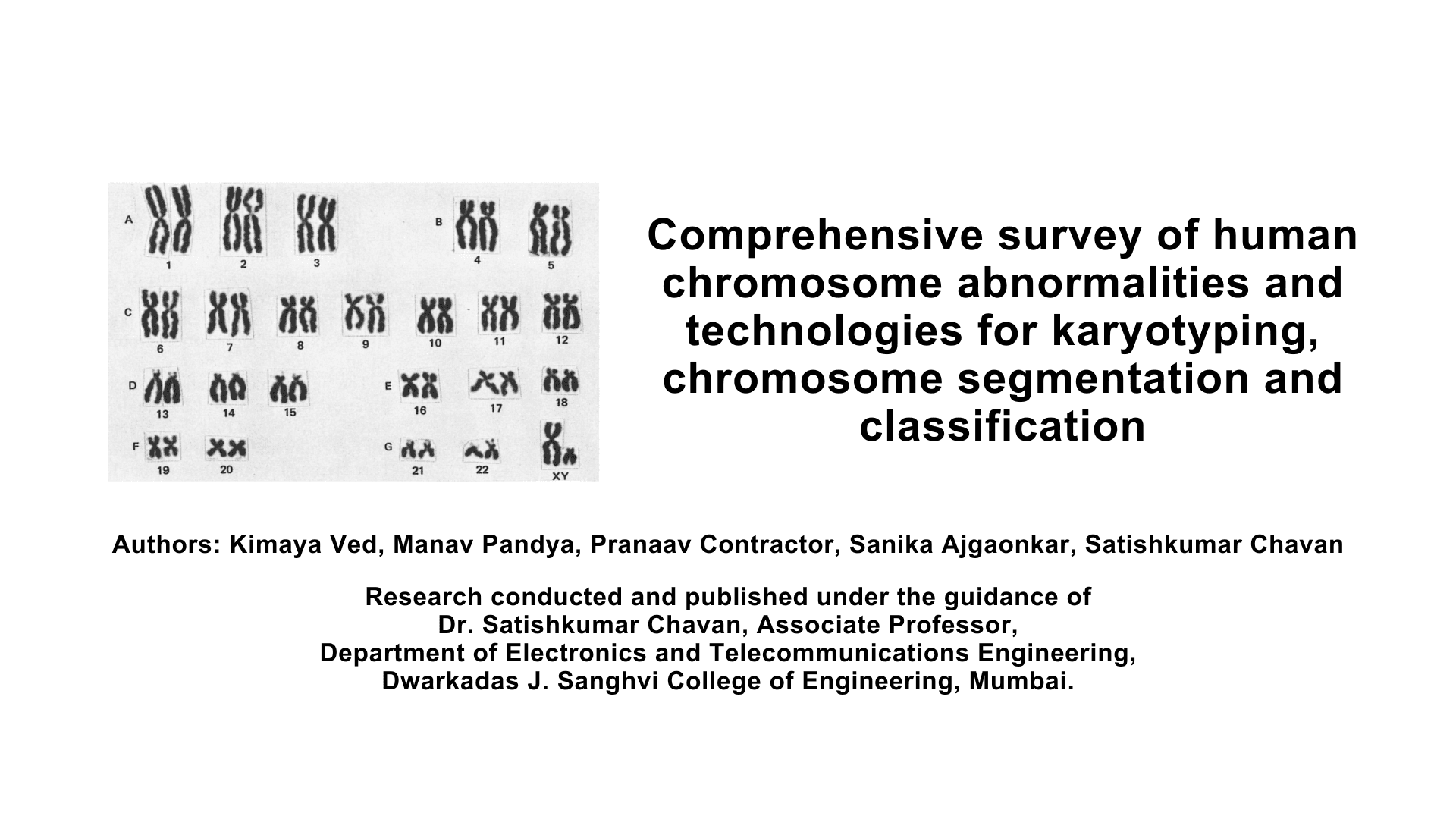
Chromosome abnormalities account for majority of the genetic diseases. The chromosomal abnormalities range from numerical abnormalities like Trisomy 21 (Down syndrome) to structural abnormalities like deletions and duplications of the chromosomes. These diseases can not curable at the advanced stages, thus for the detection of any symptoms of an inherited disease or genetic disorders in fetuses during pregnancy, advanced technologies are employed. In the past thirty years, advancements in chromosome analysis have introduced various methods for preprocessing, segmentation, and classification. Despite these innovations, chromosome classification and abnormality detection still depend on manual intervention in labs, which remains time-consuming and labor-intensive. Thus, further research in the field is required to completely automate the process. This paper presents a comprehensive survey of these abnormalities and reviews the latest technologies for karyotyping, chromosome segmentation, and classification.
Execution
This comprehensive survey navigates through the severity of various chromosomal abnormalities occurred by a disrupted cell division and identifying them by employing various methods of detection. Categorisation of chromosome began with Karyotyping where the efficacy of Deep CNN technique was 95.24%. Abnormality detection subsuming Numerical and Structural abnormalities; classification technique U-Net+YOLOv3 produced best results with 99.3%. Overall, this study offers a thorough examination of every network that has been utilized for karyotyping and chromosomal classification, as well as a step-by-step breakdown of all the procedures involved in identifying the final aberration that may be seen during prenatal screening. This helps by moving us closer to our objective of identifying any symptoms of inherited disease or genetic disorders in fetuses during pregnancy. This will aid in early detection and help one make an informed decision, potentially averting delayed abortions.
Project files