Brain Tumor Classification
Presented the research at 9th International Conference, Soft Computing: Theories and Applications, Malaviya National Institute of Technology, Jaipur, Rajasthan, India.
Mission
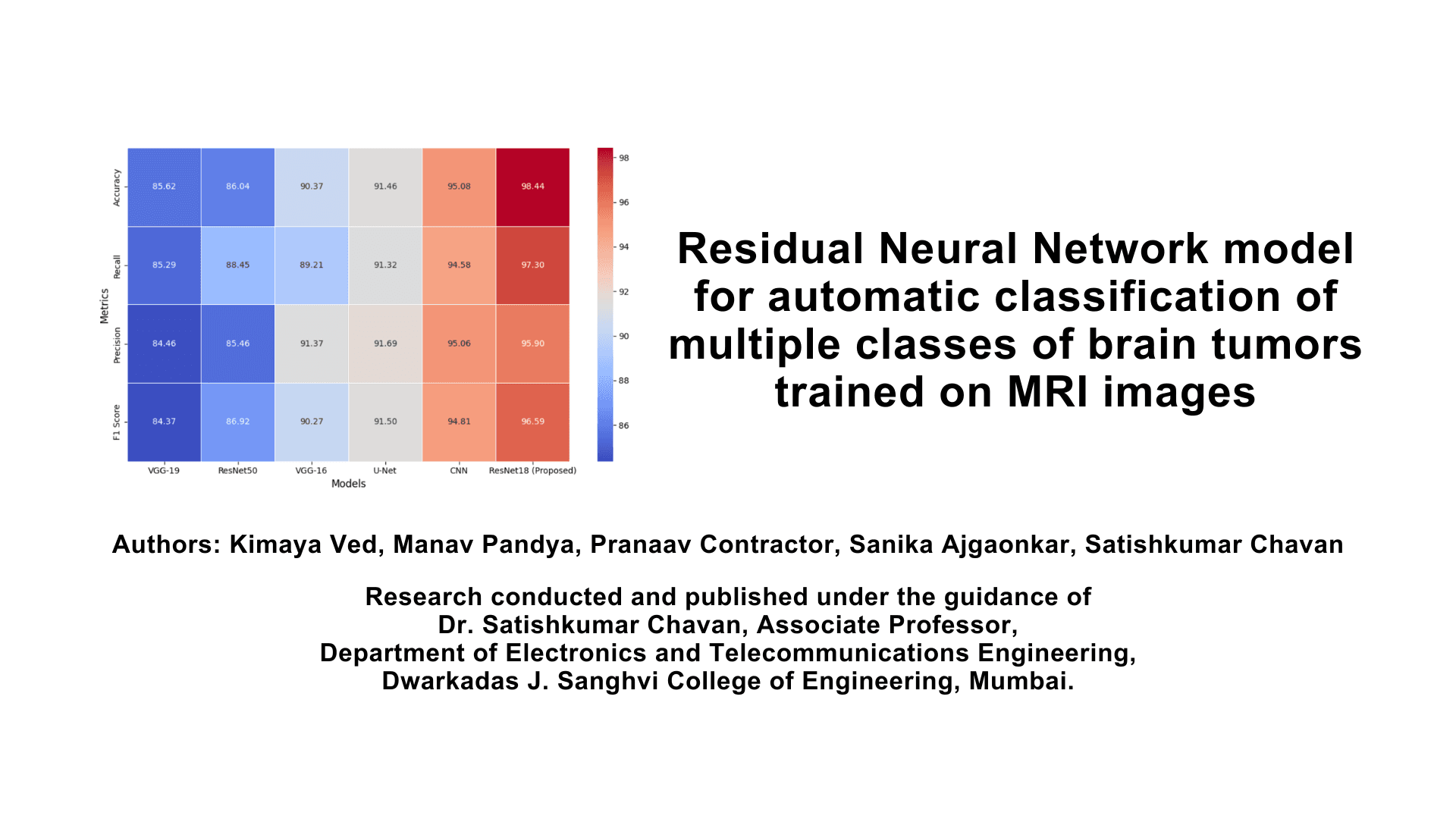
Brain tumors pose significant health risks and can vary in severity depending on their type. Accurate classification of brain tumors, such as glioma, pituitary, and meningioma, is crucial for determining appropriate treatment plans. This paper presents a classification approach for brain tumors in MRI scans. The CNN model employs convolutional layers for feature extraction, batch normalization to improve training stability, and dropout regularization to reduce overfitting. These architectural choices enable the model to perform efficiently on test data to provide reliable predictions. Trained on a diverse dataset comprising 5,848 brain MRI samples across three sources, the model effectively classifies the four categories. Among several tested architectures, ResNet18 demonstrated superior performance, achieving the highest testing accuracy of 99.69% and an average accuracy of 98.44%. Data augmentation and transfer learning further enhanced the model's performance. Evaluation metrics highlight its robustness and potential for clinical use. This automated classification approach aids radiologists in the diagnosis process with improved outcomes.
Execution
In this paper, a highly efficient, robust and accurate deep learning model is developed for classification of brain tumor images into 4 classes. The proposed ResNet18 model has achieved a remarkable overall testing accuracy of 98.44%. The residual connections and deep architecture allows it to learn complex features, leading to high accuracy and minimal overfitting. The performance metrics confirm that the ResNet18 can significantly classify the brain tumors aiding radiologists to make precise diagnostic decisions for the patients.
Even though the model shows encouraging results, future research could use a bigger and more varied dataset to further enhance performance and solve potential biases or training limits which would increase the model's applicability in real-world circumstances.
Project files