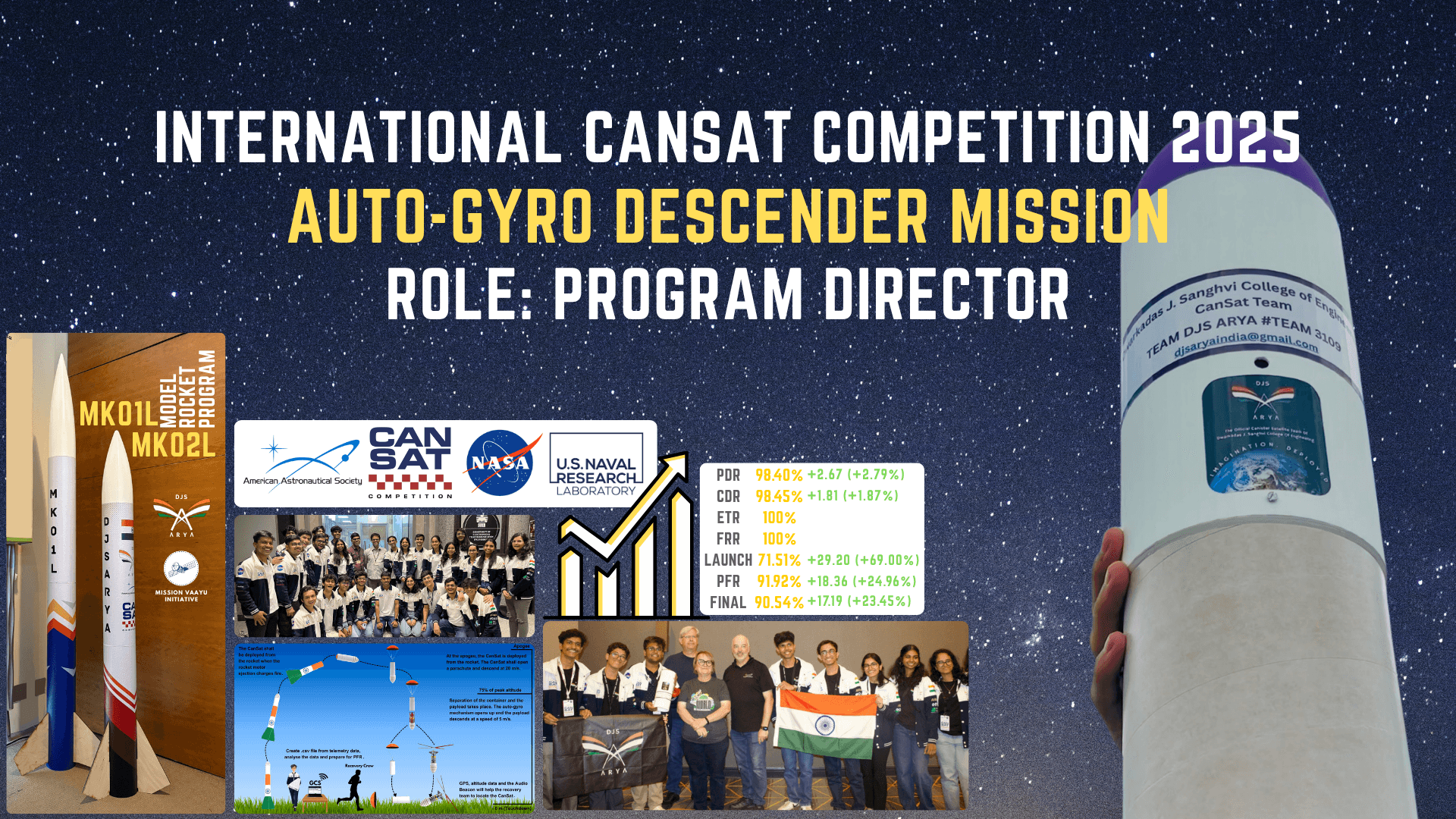
International CanSat Competition 2025
Staunton, Virginia, United States of America
Mission
The American Astronautical Society hosts this annual student design-build-launch competition. The competition challenges students to design a CanSat system capable of surviving launch and completing a scientific mission. It was the 20th anniversary of the competition.
The 2025 mission was to design a Cansat that consists of a payload and a container that mounts on top of the rocket. The payload rests inside the container at launch and includes the nose cone as part of the payload.
The container with the payload shall deploy from the rocket when the rocket reaches peak altitude and the rocket motor ejection forces a separation. The container with the payload shall descend at a rate of no more than 20 meters/second using a parachute that automatically deploys at separation.
At 75% peak altitude, the payload shall separate from the container and descend using an auto-gyro descent control system until landing. The descent rate shall be 5 meters/second.
A video camera shall show the separation of the payload from the container and the auto-gyro functioning. A second video camera shall be pointing downward at 45 degrees from nadir and oriented north during descent and be spin stabilized so that the view of the earth is not rotating.
The Cansat shall collect sensor data during ascent and descent and transmit the data to a ground station at a 1 Hz rate. The sensor data shall include interior temperature, battery voltage, altitude, auto-gyro rotation rate, acceleration, rate, magnetic field, and GPS position.
Execution
The 2025 mission was one of the most technically demanding missions we executed. Developing a reliable auto-gyro descent system required balancing passive aerodynamic stability with rapid blade deployment to ensure controlled deceleration immediately after separation. Alongside this, the Electrical Power Subsystem, Communications & Data Handling architecture, Flight Software, and Ground Control System were evolved from previous mission iterations, leveraging proven system reliability while optimizing integration and operational performance for the new mission profile.
Project files
Technologies
- Systems Engineering
- Embedded Systems
- Telemetry Systems
- CAD Modelling
- Rapid Prototyping
- 3D Printing
- Laser Cutting
- Aerodynamic Analysis
- Real-Time Data Processing
- Environmental Testing
- Systems Validation
- Failure Analysis
- Risk Mitigation
- Performance Optimization
- Systems Integration