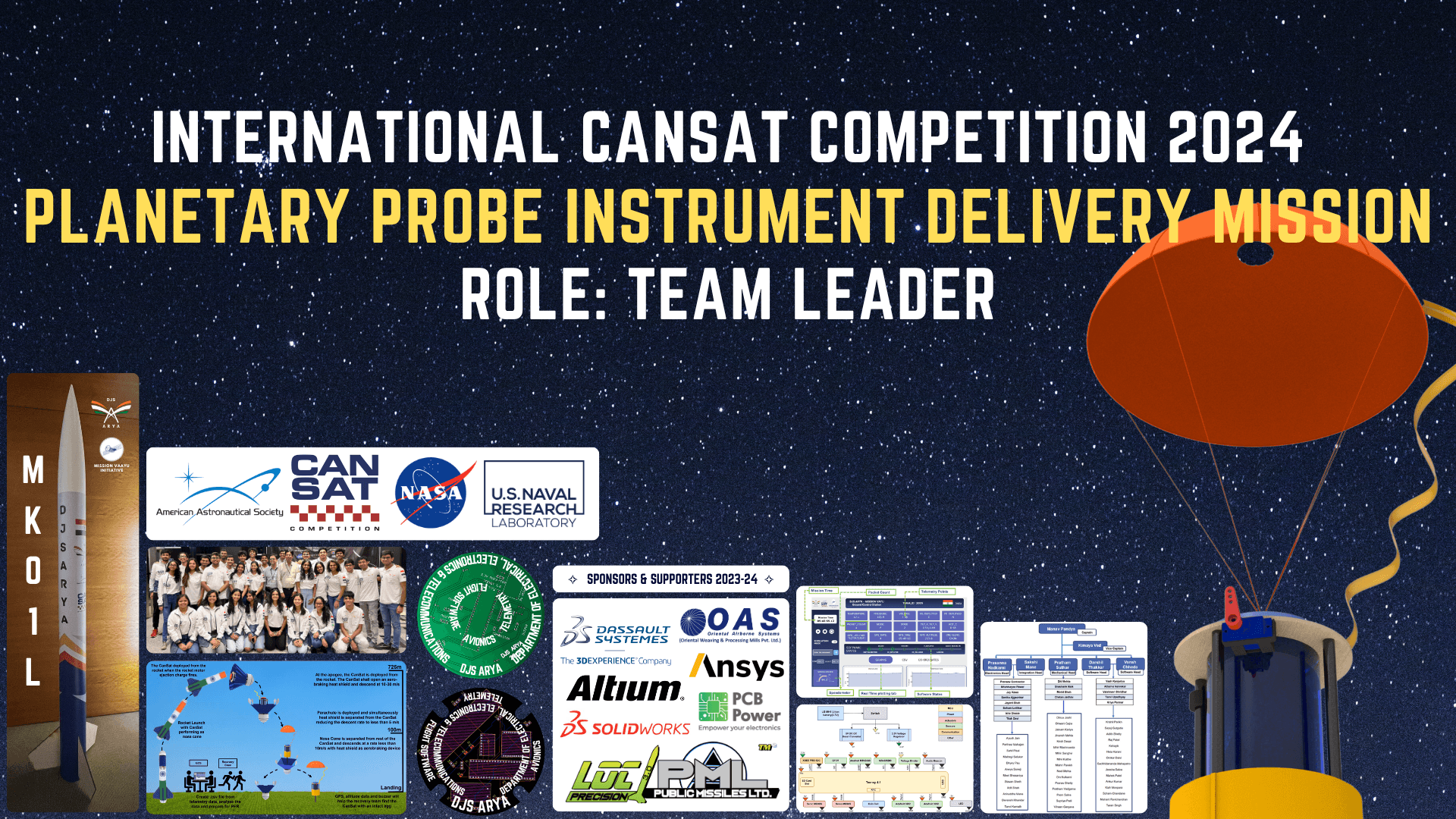
International CanSat Competition 2024
Staunton, Virginia, United States of America
Mission
The American Astronautical Society hosts this annual student design-build-launch competition. The competition challenges students to design a CanSat system capable of surviving launch and completing a scientific mission.
The 2024 mission simulates a space probe (Cansat) entering a planetary atmosphere. The Cansat shall contain the electronics, a hens egg and a detachable heat shield. The probe shall carry a single large hen's egg (provided). The egg must survive without breaking through all portions of flight. The probe shall operate as a nose cone during ascent. The operation sequence shall be:
1. The probe shall take the place and function of the nose cone during ascent. The probe is launched to a maximum altitude of 725 meters above the launch site and then deployed from the rocket when the rocket parachute ejection charge fires. The Cansat shall measure the speed of the rocket during ascent and of itself during descent. Orientation of deployment is not controlled and is most definitely violent.
2. Once the Cansat is deployed from the rocket, the Cansat shall open an aero-braking heat shield. The descent rate shall be between 10 to 30 meters/sec. The aero-braking probe must maintain a stable orientation with the heat shield facing the direction of descent. Tumbling is not allowed. Active control surfaces or other mechanisms can be used to maintain orientation. Stability shall be verified with a tilt sensor.
3. At an altitude of 100 meters, the probe shall release the aero-braking heat shield and simultaneously deploy a parachute to reduce the descent rate to less than 5 meters/sec.
4. The probe shall land with the egg intact.
The probe shall include sensors for tracking altitude using air pressure, internal temperature, battery voltage, GPS position and a tilt sensor for stability verification during descent. A pitot tube shall be included to measure the ascent speed and descent speed. A video recording camera shall be included capturing the horizontal view during ascent and landing. During descent, the camera shall point in one direction and maintain that direction.
Execution
The 2024 mission focused on simulating a planetary probe delivery system capable of surviving violent deployment, executing multi-stage aerodynamic braking, and safely delivering a delicate payload while transmitting full-flight telemetry and onboard video. The mission achieved the team's highest-ever Preliminary Design Review score of 98.75%, securing World Rank 6 internationally. However, despite the historic performance, the team narrowly missed qualification to the next stage — a setback that ultimately became the catalyst for the deep technical retrospectives, systems engineering rigor, and operational transformation that shaped the team's future success.
Project files
Technologies
- Systems Engineering
- Embedded Systems
- Telemetry Systems
- CAD Modelling
- Rapid Prototyping
- 3D Printing
- Laser Cutting
- Aerodynamic Analysis
- Real-Time Data Processing
- Environmental Testing
- Systems Validation
- Failure Analysis
- Risk Mitigation
- Performance Optimization
- Systems Integration