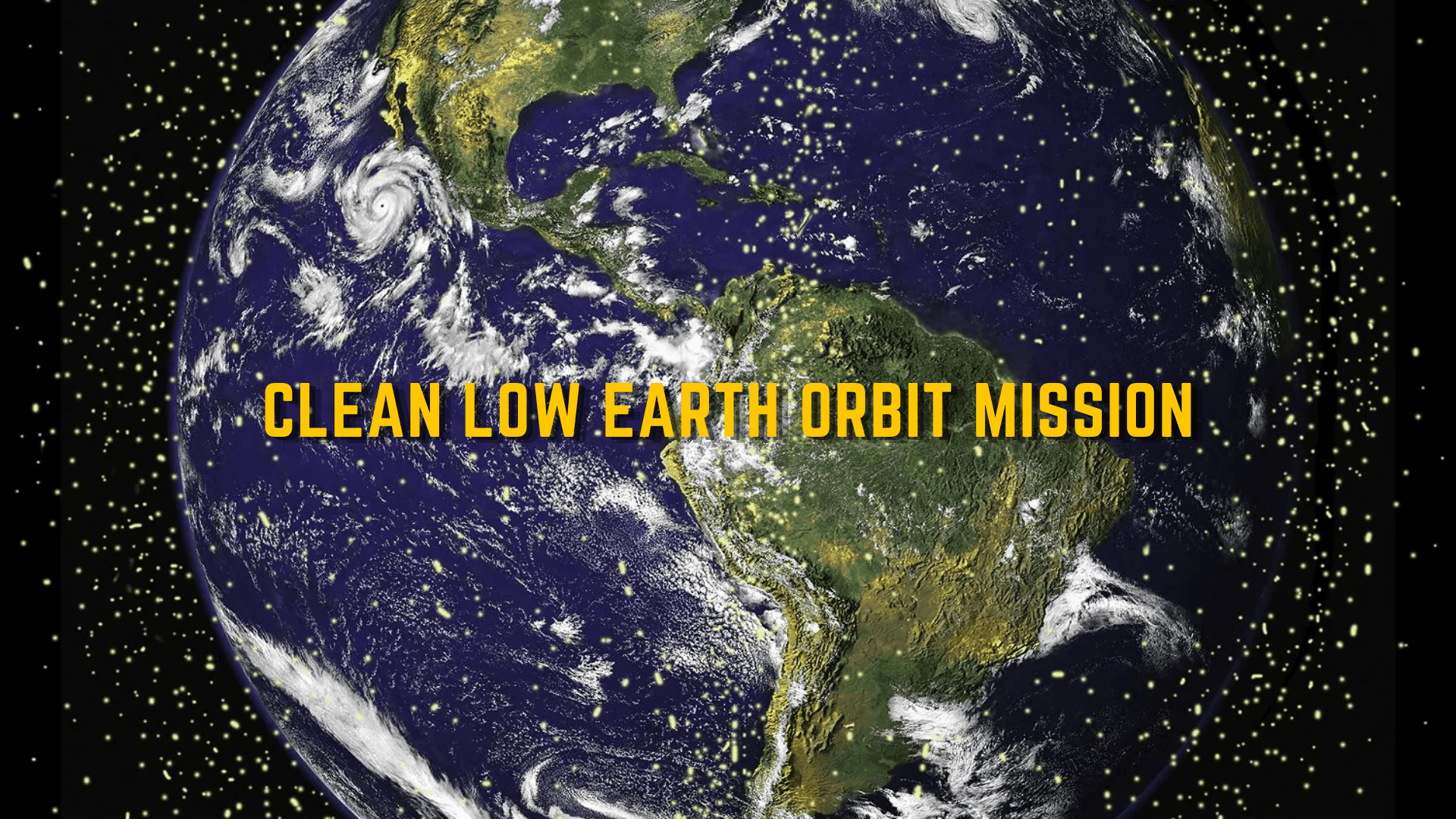
C.L.E.O. Mission
Reimagining orbital debris not as waste, but as a recoverable resource for the future of space infrastructure.
Mission
C.L.E.O. (Clean Low Earth Orbit) was initiated to address one of the fastest-growing threats to modern space infrastructure: small orbital debris. While large debris objects are actively tracked, millions of smaller fragments continue to endanger satellites, communication networks, and future missions with little practical mitigation at scale. The project set out to explore scalable methods for detecting, influencing, capturing, and eventually repurposing debris in Low Earth Orbit. Beyond mitigation, the long-term vision was to investigate whether orbital waste could someday become a usable in-space resource rather than a permanent hazard.
Execution
The project began with an extensive study of the global orbital debris landscape, existing Active Debris Removal (ADR) systems, and the limitations of current capture technologies for small, fast-moving fragments. Research focused on non-contact mitigation concepts, including electromagnetic interaction, phased-array radiation approaches, orbital perturbation methods, and alternative low-mass capture strategies. Alongside technical exploration, debris distribution models and collision-risk frameworks were analyzed to better understand high-density orbital regions and operational feasibility. The process revealed the immense engineering challenges behind small debris mitigation — particularly tracking precision, energy requirements, orbital mechanics constraints, and scalability — while also uncovering opportunities for future autonomous cleanup and resource recovery systems.
Technologies
- Orbital Mechanics
- Phased Array Concepts
- Electromagnetic Systems
- Systems Engineering
- SolidWorks
- CAD Modeling
- Autonomous Systems