CanSat India Competition
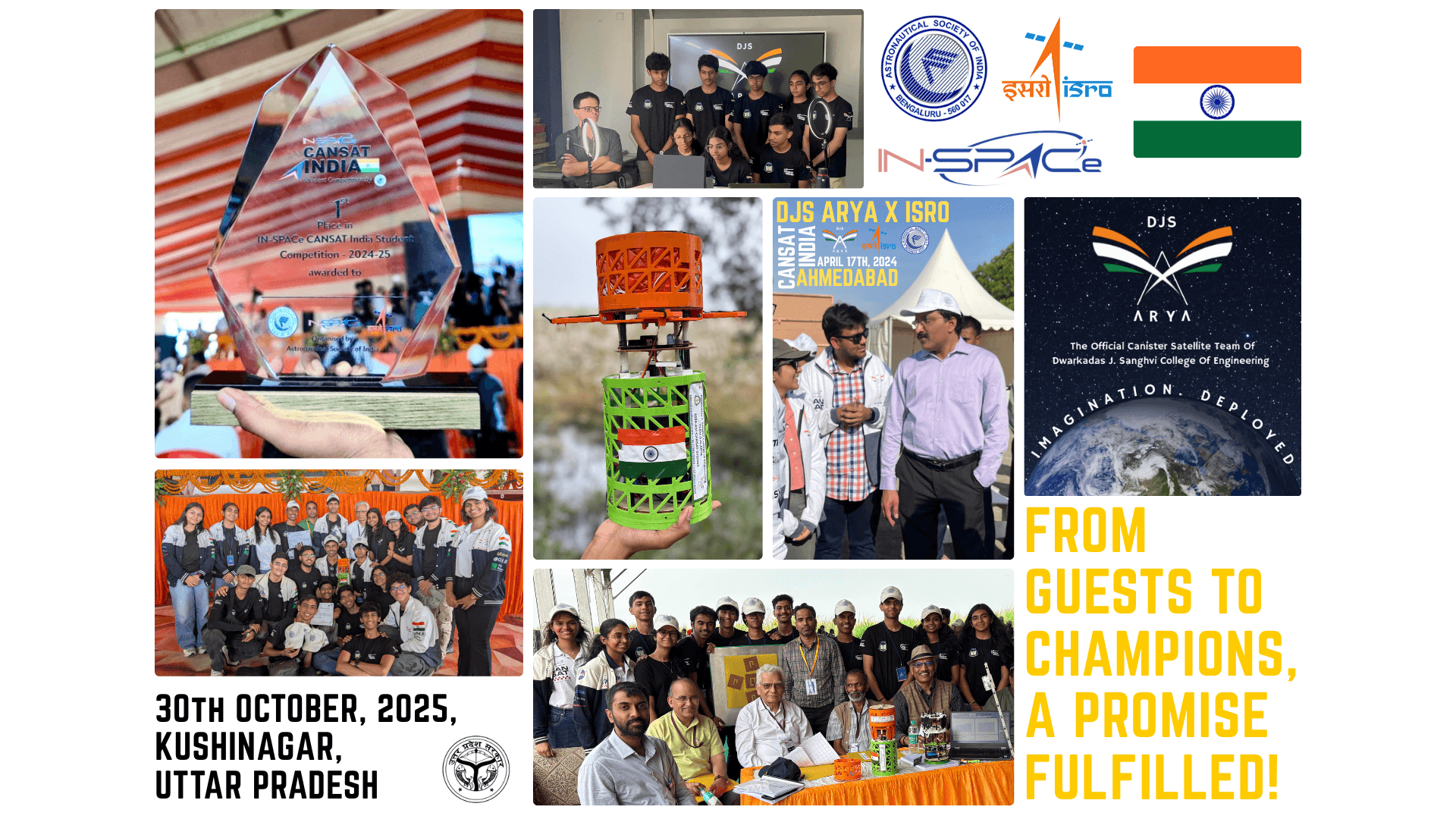
From witnessing the inauguration of CanSat India in Ahmedabad, Gujuarat to standing victorious in Kushinagar, Uttar Pradesh — a full-circle journey
Mission
The IN-SPACe CanSat India Student Competition challenged teams to design, build, and launch a fully functional CanSat capable of executing a controlled scientific mission within strict dimensional, operational, and telemetry constraints. The mission required the CanSat to survive launch, deploy at altitude, maintain stable descent characteristics, and continuously transmit real-time telemetry throughout flight.
The team's journey with the competition began in 2024 at its inaugural edition in Ahmedabad, Gujarat, where DJS Arya attended as invited guests and interacted with ISRO Chairman Dr. S. Somanath. During the event, a commitment was made that the team would return not as spectators, but as competitors capable of winning the competition.
For the 2025 edition, hosted in Kushinagar, Uttar Pradesh, the mission objective centered around developing an innovative gyro-controlled descent system capable of demonstrating controlled aerodynamic stabilization during payload recovery. Alongside the primary descent objective, the mission required the integration of onboard sensing, video capture, communication systems, and reliable recovery operations within a highly constrained aerospace platform.
Additional mission goals included implementing advanced telemetry architecture, incorporating supplementary sensing capabilities, recording the complete descent sequence through onboard cameras, and developing innovative recovery methodologies while maintaining high standards of quality, reliability, and systems integration.
Execution
The gyro-controlled descent system required extensive aerodynamic experimentation to achieve reliable active stabilization, rapid deployment, and controlled recovery within strict mission constraints. Supported by robust telemetry, communications, and ground control architectures, the mission execution reflected the structured review culture, systems engineering discipline, and operational rigor developed through years of participation in the International CanSat Competition — standards that were clearly visible throughout the competition and ultimately led DJS Arya to secure 1st place at the IN-SPACe CanSat India Student Competition.
Technologies
- Systems Engineering
- Embedded Systems
- Telemetry Systems
- CAD Modelling
- Rapid Prototyping
- 3D Printing
- Laser Cutting
- Aerodynamic Analysis
- Real-Time Data Processing
- Environmental Testing
- Systems Validation
- Failure Analysis
- Risk Mitigation
- Performance Optimization
- Systems Integration